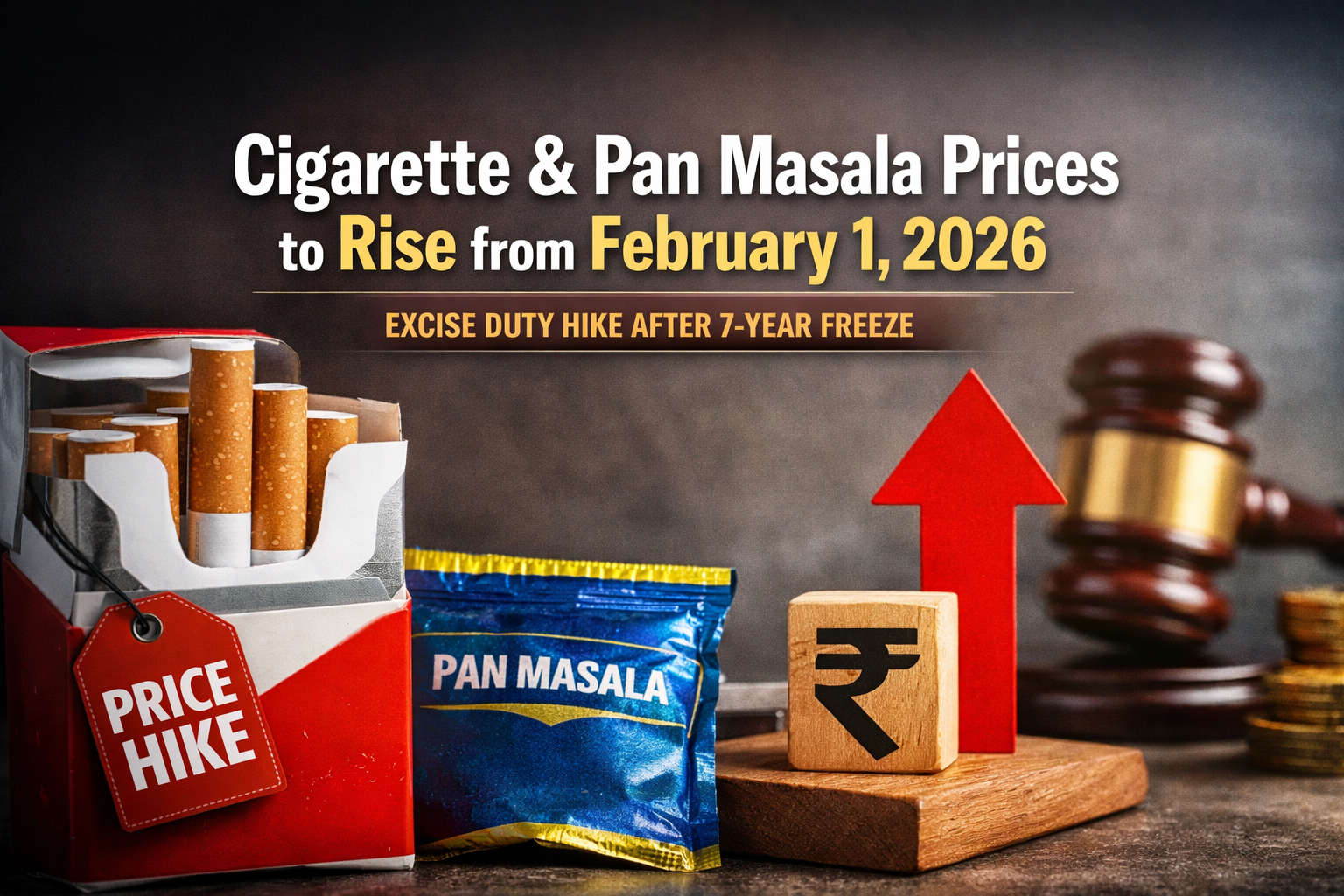
After maintaining unchanged excise duty rates for nearly seven years, the Government of India has announced an increase in excise duty on cigarette and pan masala prices rise, effective from February 1, 2026. This decision marks a major policy shift in the taxation of so-called “sin goods” and is expected to lead to higher retail prices across the country.
The move comes at a time when the government is facing rising healthcare costs, persistent inflationary pressures, and the need to mobilise additional revenue without burdening essential goods.
What Exactly Has Changed?
Since 2018, excise duty on cigarettes and pan masala remained largely static despite increasing production costs and inflation. With the new announcement, the government has revised:
- Excise duty slabs on cigarettes across different length categories
- Duty rates on pan masala and chewing tobacco products
- Overall alignment of excise duty with current economic conditions
Although the exact rate of increase varies by product category, the common outcome will be higher Maximum Retail Prices (MRP) for consumers.
Why Did the Govt Act Now?
Revenue Mobilisation Without Taxing Essentials
Cigarettes and pan masala contribute significantly to indirect tax collections. By increasing excise duty on these products, the government can enhance revenue without raising taxes on food, fuel, or other necessities.
Public Health Considerations
Higher prices are proven to reduce consumption, particularly among young users and price-sensitive groups. The move supports India’s broader public health objectives and aligns with global recommendations to discourage tobacco use through taxation.
Correcting Inflation Erosion
A seven-year freeze in excise duty effectively reduced its real value due to inflation. The latest revision restores the tax’s intended economic impact.
Expected Price of Cigarette Impact on Consumers
While final prices will depend on manufacturer pricing strategies and state-level factors, industry estimates indicate the following impact:
- Cigarettes may become costlier by approximately ₹10 to ₹20 per pack
- Pan masala and gutkha prices could rise by 8 to 15 percent
- Chewing tobacco products may see a moderate increase
In most cases, manufacturers are expected to pass on the higher tax burden directly to consumers.
Tax Implications On Cigarette and Pan Masala
Excise Duty Effect
Excise duty is levied at the manufacturing stage, but it directly affects the product’s base price. Any increase in excise duty raises the cost of production, which ultimately increases the retail price.
GST Impact on Cigarette and Pan Masala
Cigarettes and pan masala already attract a high indirect tax burden, including:
- 28 percent Goods and Services Tax (GST)
- Additional GST Compensation Cess
Since GST is calculated on the transaction value, an increase in excise duty raises the taxable value, leading to a higher GST outgo as well.
Cascading Price Effect
Higher excise duty increases the base price, which in turn raises GST and cess, resulting in a compounded increase in the final consumer price.
Impact on Industry and Businesses
Cigarette Manufacturers
Large manufacturers may witness a short-term decline in volumes. However, established brands with strong pricing power may initially absorb part of the increase. Over time, margins are expected to stabilise.
Pan Masala and Tobacco Sector
This segment faces higher compliance pressure and a greater risk of consumers shifting to unorganised or illicit products. Smaller manufacturers may find it challenging to absorb the increased tax burden.
Risk of Illegal Trade
Historically, sharp tax increases on tobacco products have sometimes encouraged smuggling and illegal manufacturing. To mitigate this risk, the government is expected to strengthen enforcement mechanisms, improve product tracking, and impose stricter penalties for tax evasion.
Who Will Feel the Impact the Most?
- Regular consumers of cigarettes and pan masala
- Low-income users, due to higher price sensitivity
- Small retailers, who may experience a temporary drop in sales
From a policy standpoint, the government views this impact as a necessary trade-off to achieve public health and fiscal objectives.
Long-Term Outlook: Pain Now, Gains Later
While consumers will face higher prices in the short term, experts believe that the long-term benefits include reduced healthcare expenditure, stable revenue growth, and consistent taxation policy for harmful products.
Conclusion
The excise duty hike effective February 1, 2026 brings an end to a prolonged tax freeze on cigarettes and pan masala. It reflects the government’s attempt to balance revenue generation with public health priorities. Consumers should be prepared for higher prices, while manufacturers and retailers will need to adjust pricing and compliance strategies accordingly.
As India continues refining its indirect tax framework, targeted increases on non-essential and harmful goods are likely to remain a key policy tool.
Contact taxgiveindia.com for professional tax related services.